07 — Chat and chat↔call integration
Choice of chat server
The discussions explored two chat servers:
- Rocket.Chat per tenant (MongoDB; named in
AGENTS.mdand the EU-privacy discussion), and - Tuwunel, a Rust Matrix homeserver (RocksDB embedded; Matrix discussion).
The design below uses Tuwunel / Matrix because the integration story with
go-meet (appservice bot, room-per-meeting, persistent in-call chat) is the most
developed, it has no extra database service per tenant, and Matrix is an open
protocol clients can reuse. This is recorded as ADR-002 and flagged for
confirmation, since AGENTS.md still lists Rocket.Chat. If Rocket.Chat is
retained instead, everything in this document that is not Matrix-specific
(identity mapping, per-tenant isolation, bot posting from go-meet) still holds;
it would need MongoDB per tenant in the shard design.
Per-tenant Matrix deployment
| Aspect | Decision |
|---|---|
| Instance | One Tuwunel per tenant, container in the tenant project |
server_name | <slug>.<platform-domain> (user ids @<zitadel-sub>:<slug>.<platform-domain>) |
| Storage | RocksDB on a tenant volume; media on the volume (S3 offload optional) |
| Federation | Disabled (empty allowlist, no outbound server list); the privacy promise |
| Auth | OIDC with the tenant's Zitadel org via a Tuwunel application; no local passwords |
| Well-known | /.well-known/matrix/{client,server} served per tenant via Traefik |
| Client | Element Web or Cinny white-labeled, or a custom React client on the Matrix JS/Rust SDK |
| Calls | Not MatrixRTC/Element Call; calls are go-meet + LiveKit |
| Version/pinning | Pin image tags; test upgrades on a canary tenant first |
The Matrix OIDC capability of Tuwunel was taken from the discussion and the project README; verify current behavior (native OIDC vs delegated auth service) before building the console flow — ADR-002, Q-05.
Integration model ("Option B")
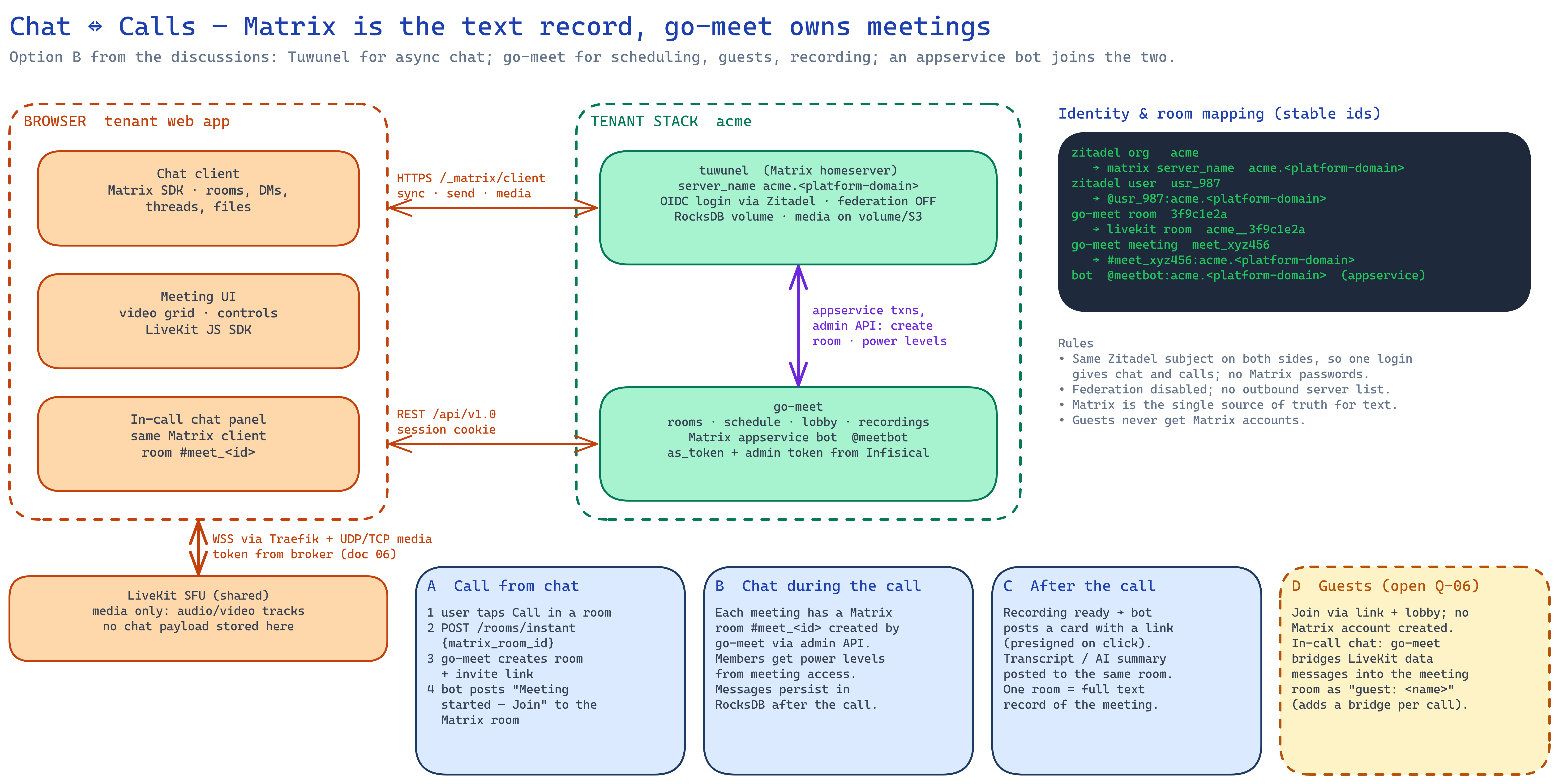
Matrix handles async chat, DMs and the text record; go-meet handles meetings (scheduling, guests, lobby, recording). They connect through:
- Shared identity — the same Zitadel subject on both sides.
- Appservice bot —
@meetbot:<slug>.<platform-domain>, registered per tenant in Tuwunel (appservice registration file withas_token/hs_tokenstored in Infisical). - Room mapping — go-meet stores
meet_room.matrix_room_id; Matrix rooms created by go-meet use alias#meet_<id>:<server>.
Scenarios (cards on the diagram)
A. Call from chat. The client calls go-meet
POST /api/v1.0/rooms/instant { matrix_room_id }. go-meet creates a room,
returns the link, and the bot posts a "Meeting started — Join" event into the
Matrix room. The sender joins through the normal join flow (06).
B. Chat during the call. The meeting UI embeds the Matrix client against
Tuwunel for the in-call chat panel. At meeting creation go-meet (via the
homeserver admin API / appservice) creates or reuses the meeting's Matrix room
and sets power levels from meeting access (owner/admin → moderator, members →
default). Messages persist after the call. LiveKit data channels are not
used for chat; canPublishData is granted only if another feature needs it.
C. After the call. go-meet's bot posts a recording-ready card (presigned link generated on click, not at posting time), transcript and AI summary. The Matrix room is therefore the complete text trail of a meeting.
D. Guests. Guests join through the go-meet link and lobby and never get a
Matrix account. Their in-call chat must be bridged: go-meet subscribes a
headless participant to the LiveKit room and mirrors data messages into the
meeting room as guest: <name> (adds one bridge per active call). Alternative:
guests get no chat. See Q-06.
Data ownership
| Data | Owner | Where |
|---|---|---|
| Messages, rooms, membership, reactions | Tuwunel | RocksDB tenant volume |
| Chat attachments | Tuwunel | Tenant volume (or tenant bucket prefix chat-media/ if offloaded) |
| Meetings, schedules, ACLs, lobby, recordings metadata | go-meet | Tenant DB on shard |
| Recordings, transcripts | go-meet via Egress | Tenant bucket |
| Identity | Zitadel | Shared instance |
Operational notes
- Tuwunel is a single process; the tenant's Matrix is a single point of failure for that tenant. RocksDB backups are volume snapshots taken with the container quiesced (or using Tuwunel's supported backup mechanism).
- Rate limits and registration are admin-controlled (no open registration).
- Per-tenant resource caps (CPU/memory) are set on the Coolify service so one busy chat cannot starve others on the host.